
I have decided to write about this Upper-Level (AP/Pre-AP) activity that I created this past school year. I am sure that I did not “create” the game or idea and if someone has already written about this, please let me know so I can give credit.
In preparing my Spanish IV students to continue on in the AP Spanish Language and Culture course, I know that my students must engage with authentic sources and write or speak while referring to them. AP World Language courses and the test require students to write an argumentative essay using 3 sources (two print and one audio) in 45 to 55 minutes. This is quite the task for any person to take on and complete with success without the use of technology or any resources.
I feel that it is my job in Spanish IV classes (a vertically aligned course getting some students ready to take AP Spanish) that students be able to interpret and develop their thoughts in written and spoken Spanish about a great variety of topics. There have been some years that we have written argumentative essays in level IV, but I have concluded that my students do not need to write these essays in level IV. What I must do is provide the building blocks for helping my students develop an argument and the ability to express and support their opinions in Spanish because the students that continue on in the AP Spanish Language and Culture class will have many opportunities to write full argumentative essays.
In level IV, I incorporate many transition words and helpful academic expressions with my students throughout the school year in order to develop their thoughts in spoken and written Spanish. In fact, I always require students to use this vocabulary during writing and speaking tasks. Here are three ways that I provide exposure to these academic words:
- My Weekly Passwords – This post explains briefly how I use Passwords. [I choose these all intentionally including expressions like Sin embargo (however), De hecho (in fact), Se puede ver que (one can see that)]
- Discussion Days / Having Critical Conversations in the WL Classroom (my rubric states: describe your thoughts/opinion, describe your level of agreement, describe what you learned/found out)
- Socratic Seminar/Circle Assessments, this post describes my process
This new Presentational Speaking task/activity: The Claim Game
Making and supporting a claim and knowing the counter argument is the key to developing an argument. I feel this activity provided a great opportunity to do so in a gamified way. More importantly, it was successful with students and they enjoyed working in teams and the competitive nature of the game. But in reality the “game” was like a spoonful of sugar helping the medicine go down because it accomplished my goals of teaching academic skills and vocabulary in the most delightful way.
The goal of this 60-90 minute activity is for teams of students to support a claim that I make by using a source that I provided them. Whichever team gives the best 1 minute argument in Spanish wins the point.
In my Spanish IV reflection I wrote about using more infographic type pieces this year, many of which were from Mexican artist Roy Gallardo monos’ collection. For this activity I printed many of these infographics and used them as the sources (as I continue to explain the game, think about what else could be used as short-text sources: social media posts, summaries of articles/films/stories etc.).
For my Claim Game, I printed infographics based on our current themed unit which was Sustainability and Environmental Challenges. Each team had the same infographics, and I copied as many sets of infographics as teams I knew I would have (in my case there were 5 students per team). Before class, I brainstormed a list of claims that I could make using the infographics I was providing teams like
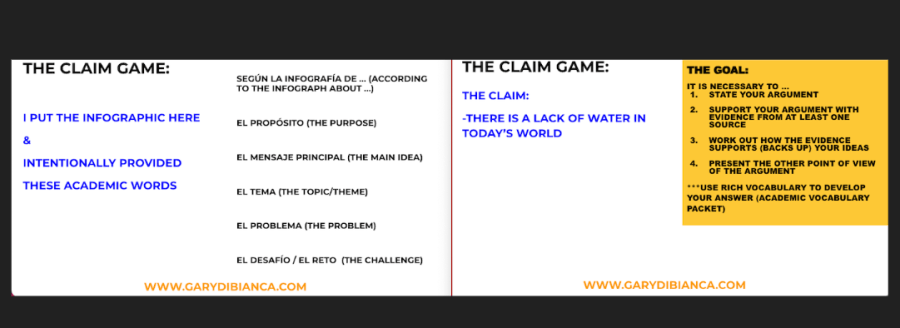
“Traveling by cars is the best form of travel,” “There are benefits to natural disasters,” “Pollution is worse because of humans,” and “There is a lack of water today.”
For each round, I would put one of these statements on my screen, and teams would have two minutes to prepare their oral response which must A.) state both sides of the argument and B.) then support one side of the claim using evidence from at least one of the sources.
After the two minutes of preparation time (for the first few rounds, I think I had to give them 3 minutes, then 2.5 minutes) to find their groove working within the team. Then they were ready to present in Spanish their 1 minute arguments in which I had to hear from at least 4 members of the team (and every student in the team within two rounds); the other teams could not write anything nor brainstorm anymore while each team presented. After I heard each team, I decided which team earned the point with the strongest argument. When doing this activity this past year, I know that I only had three teams but of course there could be many variations of this game with regard to your class sizes like only hearing from two or three teams at random etc.
I hope others are able to use this idea in the future to help prepare students for the argumentative essay while not writing nor grading argumentative essays. 🙂
Also, to support students, they had these notes on my screen (again I am always intentionally including academic vocabulary to build their foundation of the words they will see and need in academic settings or on the AP Language and Culture Test).
| IT IS NECESSARY TO … 1. STATE YOUR ARGUMENT 2. SUPPORT YOUR ARGUMENT WITH EVIDENCE FROM AT LEAST ONE SOURCE 3. WORK OUT HOW THE EVIDENCE SUPPORTS (BACKS UP) YOUR IDEAS 4. PRESENT THE OTHER POINT OF VIEW OF THE ARGUMENT ***USE RICH VOCABULARY TO DEVELOP YOUR ANSWER (ACADEMIC VOCABULARY PACKET) | HAY QUE … 1 . DECLARAR TU ARGUMENTO 2. APOYAR TU ARGUMENTO CON EVIDENCIA DE POR LOS MENOS UNA FUENTE 3. ELABORAR CÓMO LA EVIDENCIA APOYA (RESPALDA) TUS IDEAS 4. PRESENTAR EL OTRO PUNTO DE VISTA DEL ARGUMENTO ***USAR VOCABULARIO BIEN RICO PARA DESARROLLAR TU RESPUESTA (ACADEMIC VOCABULARY PACKET) |
 My Mosaic of World Language Teaching
Pingback: Summer Series Reflections 2023 – My Mosaic of World Language Teaching
Pingback: Taming the beast: AP Argumentative Essay – Señora Chase