Oh my god oh, my god you guys (musical lyric, anyone, anyone?) As I was writing this, I realized that I hate reading posts like the one I just constructed (worse than that, it is probably how I construct all of my posts – more deep reflection on this is needed). Anyway, this post is like when I’m looking for a recipe, and the beginning of the post is a ton of exposition that the author, like me, has carefully crafted – but all I want to do is read the recipe. So with this realization, here is a Jump to the Craft link, just like the “Jump to Recipe” button that I always choose. But remember, if you do consider Jumping to the Craft, I wrote this with passion and a purpose (and I am certainly going to remember this the next time I want to hit Jump to Recipe).
As much as I love the Interactive Presentations that I wrote about yesterday, this year in Spanish 4/IV Honors, it was the end of the year, and I just didn’t feel like doing one more interactive presentation (which, for the past four years, has been my final week of school assignment). Instead, I was inspired to figure out a way to do a craft related to Hispanic or Spanish culture that would last four days for the final week of school (my level 4 students use the STAMP exam as their final exam grade, which we took mid May). So for about a week, I thought about what to do for this student craft project and was getting nowhere. When I get stuck like this, I try to talk it out with colleagues and friends. When doing so, one of my colleagues asked me: “Have you asked Google Gemini for any ideas?” And no, my answer was no, because in my frame of thinking as a problem-solver, AI is typically my last resort instead of a first or second. Now, when preparing to do a craft with students a lot goes into my thoughts:
- Do I have the materials or would they be affordable because I would be paying for them?
- Would high school students enjoy doing it?
- In this case, could it be completed in four days?
When I was finally ready to talk with Gemini, this is how our conversation went. I asked for 10 ideas for a four-day craft that was related to Hispanic or Spanish cultures to do with high school students. As I continue to explore using AI as a problem-solving tool, I realize that I am going to be having a conversation with Gemini to brainstorm, which is what I typically do with other people or myself, as my husband can attest. I asked for more ideas than the initial ten, eventually asking for about five more. Along the way, I would ask for four day step-by-step directions for various craft ideas also. I just had this conversation for no more than 10 minutes.
Here’s the beauty of how the creative-thinking process works. I saw a craft that I have wanted to do with students for 24 years, but I could never figure out how: I have always wanted to make three-dimensional Mexican Alebrije with students! I have successfully had students draw and color these for many years, but I could never figure out how to make them 3-D sculptures. In many parts of Mexico, you can find these colorfully painted wood carvings or papier-mâché animals called alebrijes, which are typically creatures that are a fusion of three different animal species. You can find out more information here.
For years I’ve thought about using modeling clay, getting soft wood to carve, my elementary school teacher husband even did a workshop many years ago that used large pieces of driftwood to create them – but sourcing all of these materials and supplies for those different versions of the craft always seemed overwhelming. In this reflection, I feel it’s really important to highlight the concept of creation and the creative-thinking process. First off, it’s important to know that any idea we’ve ever had remains in our brains and can be ignited at any time. I do believe the brain does this automatically, but I also believe that people, who practice thinking creatively and are open to the process, know that ideas are like seeds and at any time they can germinate or be sparked.
In fact, when I actually presented the final craft activity to my students, we talked about my creative process (and yes in the target language), and I was very pleased that I incorporated a life lesson for my students about how I see and develop any project, lesson/unit, or art in my personal life. This really was fantastic to share with students as a final lesson for their junior year because it is so important to me as a person and I think all people can be CREATIVE.
Back to the good stuff and the Alebrijes. The first proposed Alebrije craft that Gemini recommended was using casting plaster (or plaster of Paris) and right away that seemed too much for me. So I continued to have the conversation with Gemini about different materials to use with the end result of the three-dimensional sculpture. Then it had the brilliant suggestion – something I’ve never thought about – and I’m sure my eyes lit up because I knew this was it!
The idea was simple (and it can be used to create ANY 3-D sculpture): use aluminum foil to construct the sculpture, then cover it with light beige masking tape, and paint over it with acrylic paints. Oh my goodness – this was perfect. I knew I could source these materials easily just by going to my favorite discount stores that have close-out departments that sell discounted, discontinued, or extra inventory items; I must add now that I love shopping at stores where I can find a bargain and it is like a mini-hobby that I enjoy. I knew that the store in my town had masking tape for $0.50 each so I could easily go there for the tape (Amazon was selling a 7 roll pack for around $16. and the acrylic paint set that I almost bought on Amazon was $23). So one day, I started at a close-out store location closer to work. They had sets of five colorful acrylic paint tubes for $1.00, black acrylic paint, and foil. Then, I hit the location closer to my house – and jackpot! They had masking tape and paintbrushes for about 10 for $1.00*. I knew I had some acrylic paint at home that I could use too, but all in all, I spent less than $15 for this project – which was a great triumph for me as a bargain shopper! So now it was time to get to crafting to make my example.
*This is about when I had the AHA realization moment about this post being like the recipe websites. Oy
The Craft: Mexican Alebrijes
Materials:
- aluminum foil
- light beige masking tape,
- acrylic paints
- paint brushes
- paper/plastic plates (plastic lids from to-go-containers) for paint palettes
- plastic/glass cups or jars for water for painting
- newspaper to cover working surfaces
In preparing for the craft, I showed my students pictures of Alebrije and we talked about how many are constructed with three different animal elements in mind. I showed them pictures like these from my personal collection and I showed them the steps that we would do for the art project.
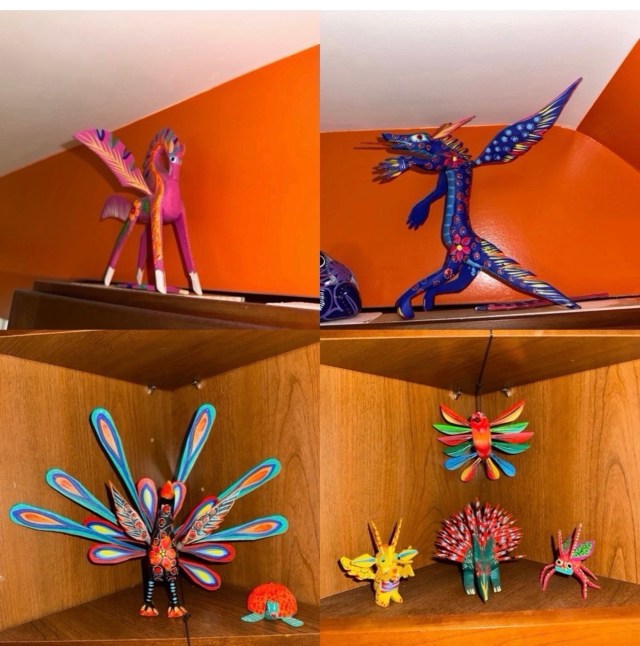
They then went home to think about and perhaps make sketches using the various elements of animals and then they would come in the next class and start building.
Step 1: Conceptualize the creature. Sketch it out. Think about how you are going to make the mold out of the foil.
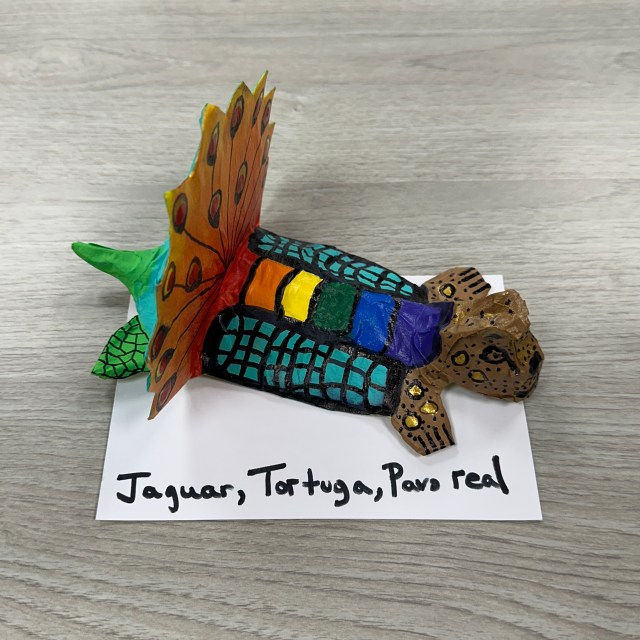
In my example, I used wood carvings of a turtle and jaguar head that I had at home to create the base – most of my students just molded the foil without any molds. So easy!
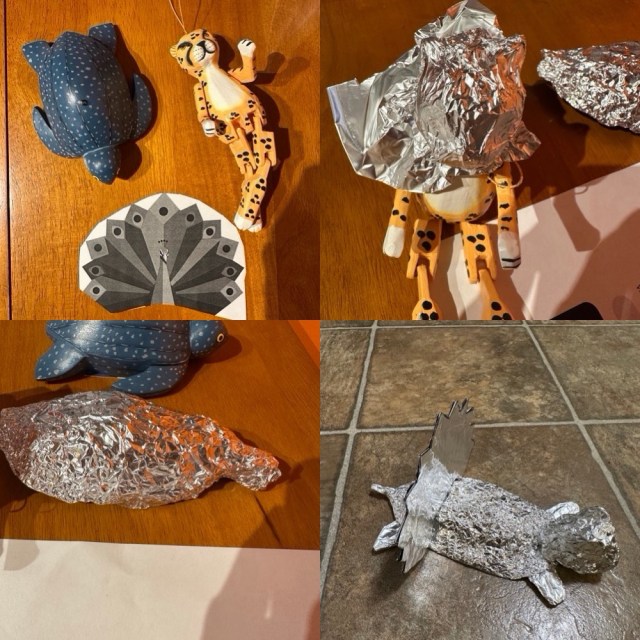
Step 2: Mold the foil into the creature and then cover it with a layer of light beige masking tape.
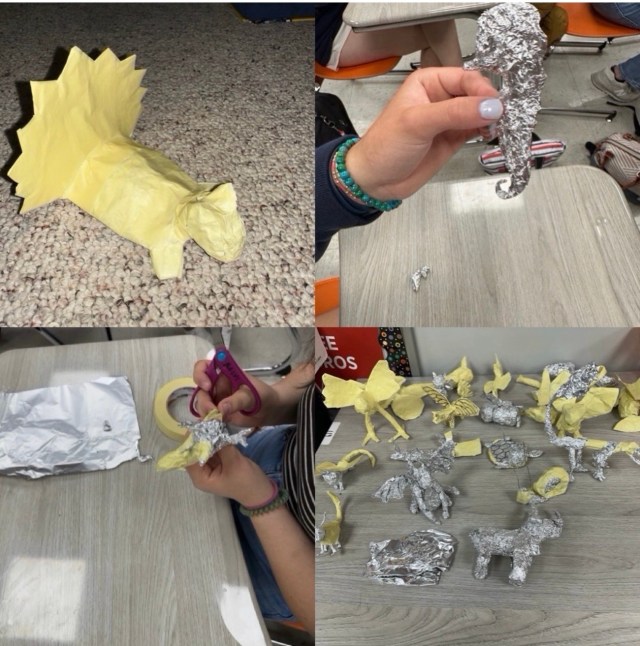
Step 3: Paint the alebrije with acrylic paints.
Step 4: Let it dry.
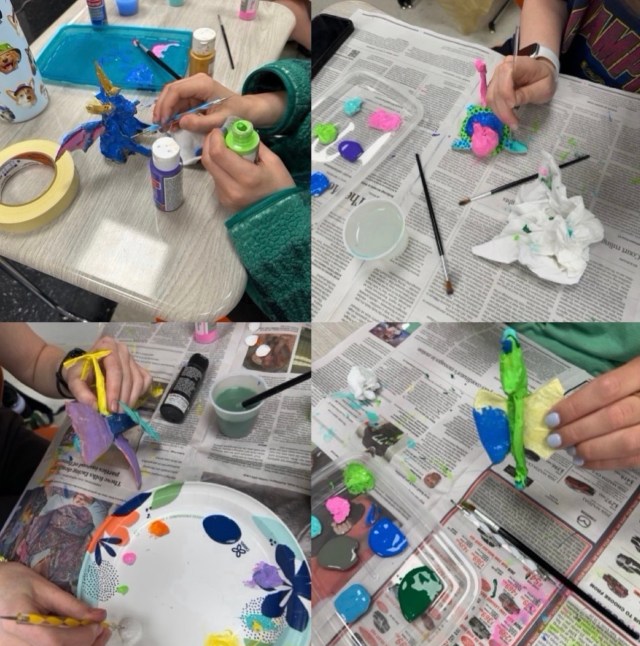
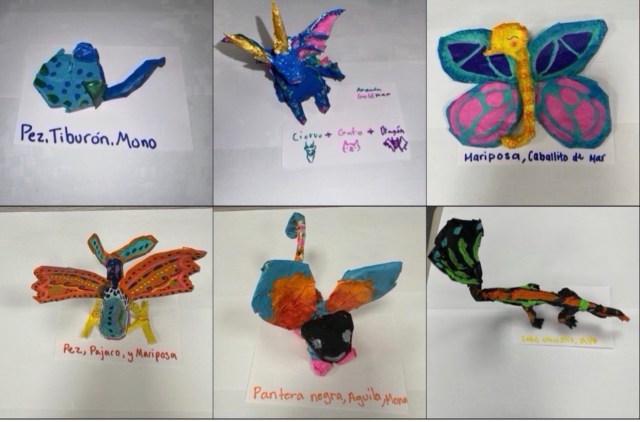
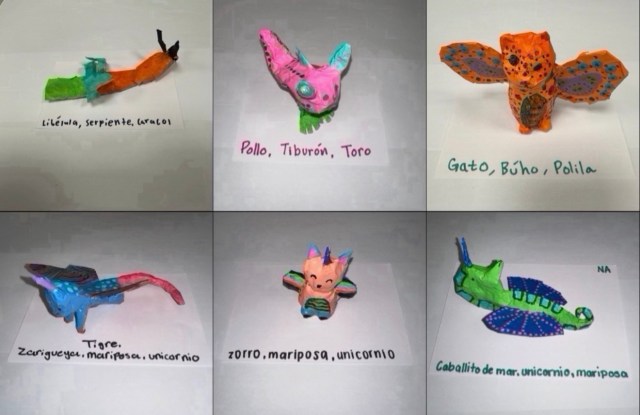
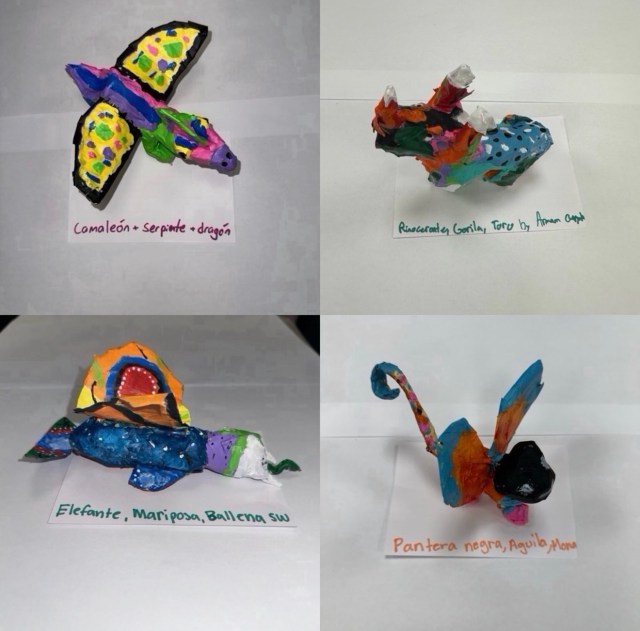
I hope you can sense the excitement I was feeling about this project. I was super happy with the end products. To incorporate a bit of Spanish, I had students write down the names of the three animals that inspired their creation. But again – it was the last week of school, and after all the hard work and dedication this group put into their Spanish proficiency this year, that was plenty!
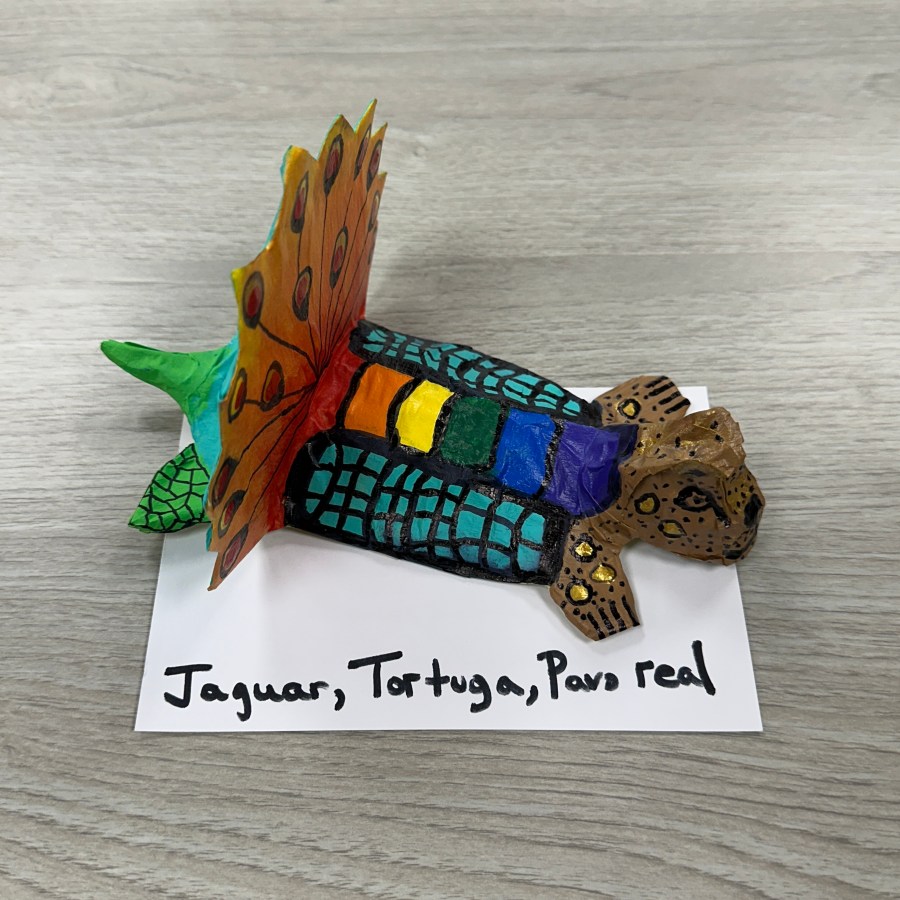
Hopefully you can use this craft down the road or that by reading through my process, it might spark a creative idea for you in the future. And just because I love sharing, I did not even realize that this craft could be used to create any sculpture in any class until I was writing my social media tag. Here were some of the final products. Have a terrific school year!


Bless you for doing this, Gary!
I just sent this off to our art and upper-school Spanish teachers, because I so want to do it…I don’t believe I can, in my Pre-K through grade 2 classes. (The grade 2 kids are feral, though they might enjoy it.) We did it as an elective with very expensive modeling clay a couple of years ago, and I wasn’t really happy with the outlay as compared to the results. Kids at our school have made huge dragons out of these materials, but never attempted alebrijes, and last year the art teacher asked me for my alebrije materials (slide show, books, etc) to start thinking about how to do it. So now she has a clear direction. THANKS!!
Michele
>
LikeLike
Thank you so much letting me know your connection to this post. I appreciate it and am so glad you shared it.
LikeLike